

Is the Accountancy Industry Failing Female Colleagues?
The past decade has seen increased focus on gender equality in the workforce. This follows the introduction of mandatory gender pay gap reporting for companies with over 250 staff coming into effect in 2017, with the first data published in 2018.
Alongside pay gap reporting, efforts in accountancy to attract, retain and ensure progression of women within the profession have included coaching, mentoring and bespoke training programmes.
Meanwhile, the Covid-19 pandemic also highlighted that greater hybrid and flexible working patterns, both of which previously regarded primarily as something for women juggling caring responsibilities, can be of use and benefit for everyone.
Whilst these changes are undeniably positive, women in accountancy still face significant challenges.
At the early careers stage, accountancy has enjoyed good traction with female students, with pay gap figures closer to gender parity for men and women. However, as the chart below from the Financial Reporting Council (2025) Key Facts and Trends in the Accountancy Profession (October 2025) shows, four out of the seven accountancy examining bodies have experienced a decline in female students between 2020 and 2024. Of the three that haven’t recorded a decline, growth has been very modest or stagnant, for example, the ICAEW has consistently recorded a female student rate of 46% over the time frame.
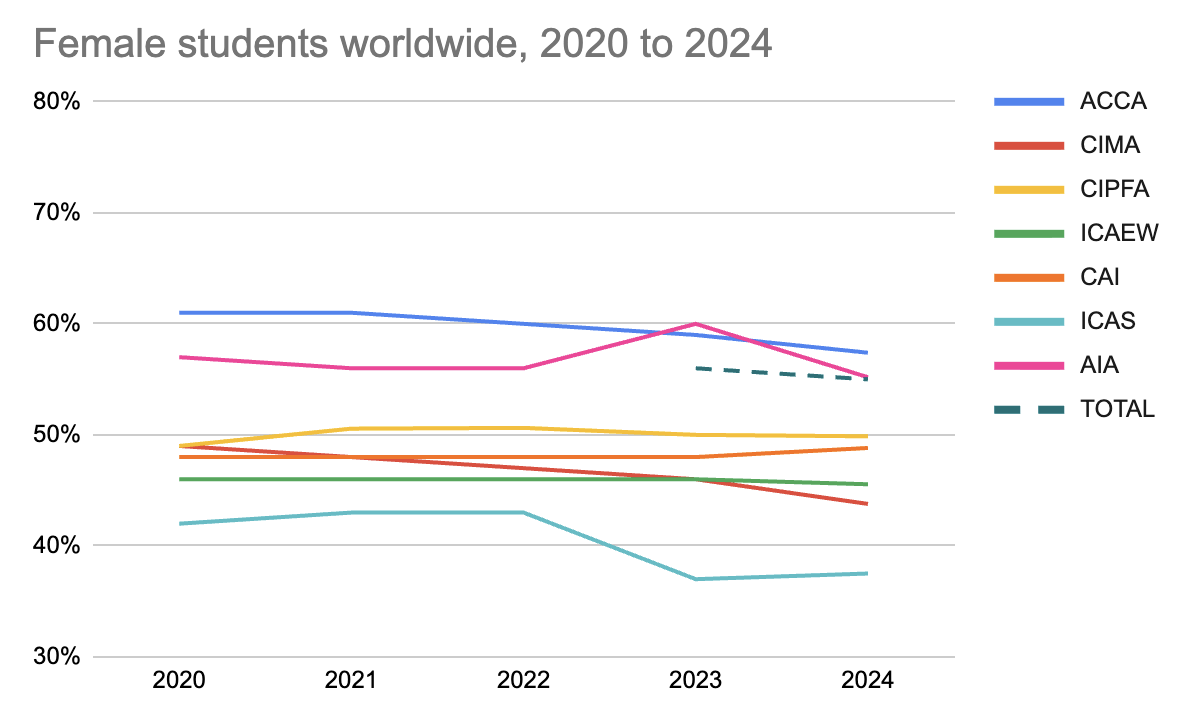
Female Students Worldwide, 2020 to 2024
Note: Until 2022, the FRC asked the professional bodies to provide the percentage of female students worldwide. Hence, the total column was the average of the percentages of female students worldwide. From 2023 onwards, the FRC has asked each body for the total number of their female students worldwide, hence the total percentage is calculated as female students of all the bodies worldwide divided by total of students of all the bodies worldwide.
Progression
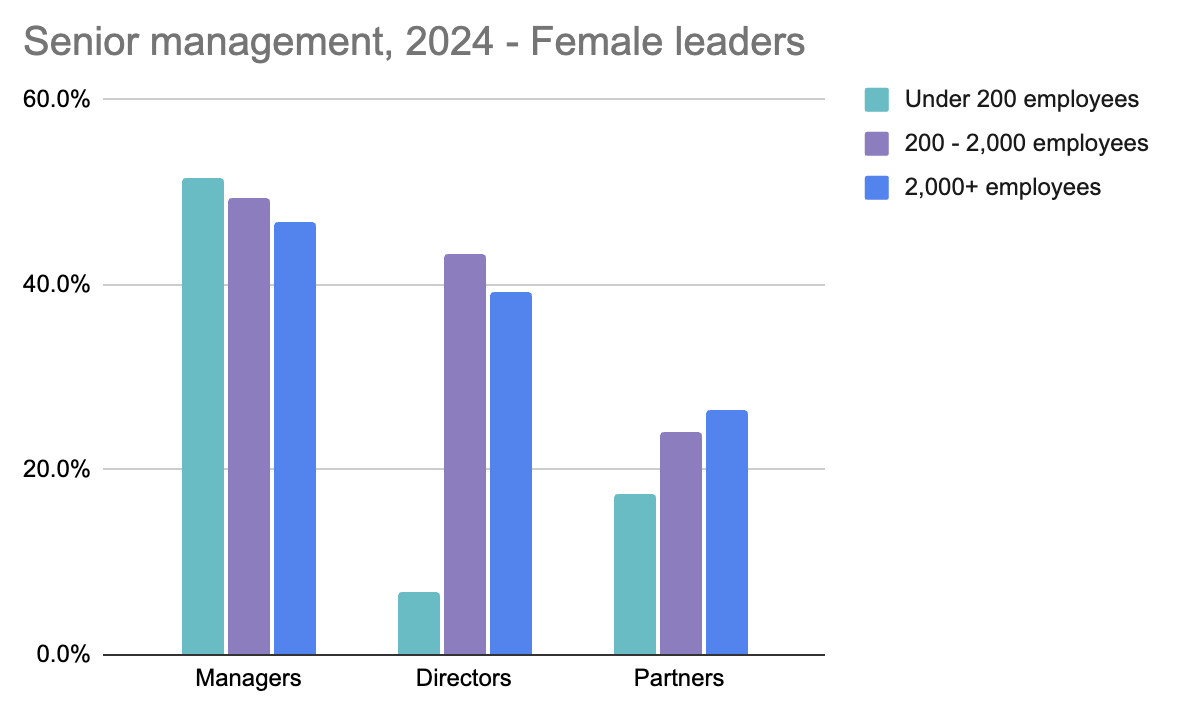
As women progress through the workforce, there is a decline in representation at Director and Partner level. The chart below from the FRC’s 2025 data shows that this is particularly pronounced in smaller firms but even in the larger firms (2,000+ employees), female representation at partner level in 2024 was still only 26.5%.
This figure is further supported by findings in the 2025 Top 75 Firms report by Business and Accountancy Daily. The survey found that of the 9,000 partners in the top 75 UK accountancy firms, just 2,400 (27%) were female. Whilst this represents an increase from the 2024 figure of 25%, progress around this is slow.
Figures of those that have moved out of accountancy firms and into industry also paint a similar picture. The latest FTSE Women Leaders report (published February 2026) shows that whilst progress has been made in relation to the women on boards target, with 69% of the FTSE350 companies achieving 40% representation, the types of roles women are fulfilling on boards is telling.
Amongst the FTSE350, women represent 82% of Human Resources Directors, 44% of General Counsels, 57% of Company Secretaries but just 21% of Chief Information Officers and Finance Directors respectively. These latter two positions are of particular importance given the increased emphasis on digitisation and AI, alongside the CFO often being a pathway to CEO positions.
A recent (June 2025) survey by Chartered Accountants Worldwide (CAW) aimed to better understand why women’s careers in the profession are restricted. Unsurprisingly, the main barrier was childcare with 42% of women citing that as a challenge to career advancement. The survey also aimed to understand the experiences of both genders and posed questions around experience of barriers to progression. 21% of men stated they hadn’t experienced any barriers to progression, compared to just 6% of women.
So this International Women’s Day, what can YOU do to improve gender equality in the accountancy industry?
1. Support Equal Opportunities
Both men and women can advocate for fairness in hiring, promotions, and pay.
Promote transparent salary structures.
Encourage diverse hiring panels.
Support policies that address gender pay gaps.
2. Address Harassment and Discrimination
Everyone shares responsibility for creating a respectful workplace.
Report inappropriate behaviour.
Support colleagues who experience harassment.
Bystanders should intervene or escalate issues when necessary.
A culture of accountability protects everyone.
3. Practice Inclusive Leadership
Leaders and team members can ensure everyone’s voice is heard.
Invite contributions from quieter team members.
Avoid interrupting or talking over colleagues.
Recognise and credit ideas fairly.
This helps prevent situations where women’s contributions are overlooked or attributed to others.
4. Share Caregiving Responsibilities
Equality at work is closely linked to equality at home.
Men taking parental leave and flexible work options normalises caregiving for all.
Organisations should encourage fathers and partners to use family-friendly policies.
When caregiving is shared, women face fewer career penalties.
5. Promote Flexible and Fair Work Practices
Flexible work policies help reduce gender inequality.
Support flexible schedules for all employees, not only women.
Encourage results-based performance rather than presenteeism.
Normalise hybrid or remote work where possible.